
INDUSTRY APPLICATIONS
Explore Aluminum Foil Packaging by Industry
Find packaging applications relevant to your operation across six food sectors. Each pathway highlights container formats and key considerations to review before product selection.
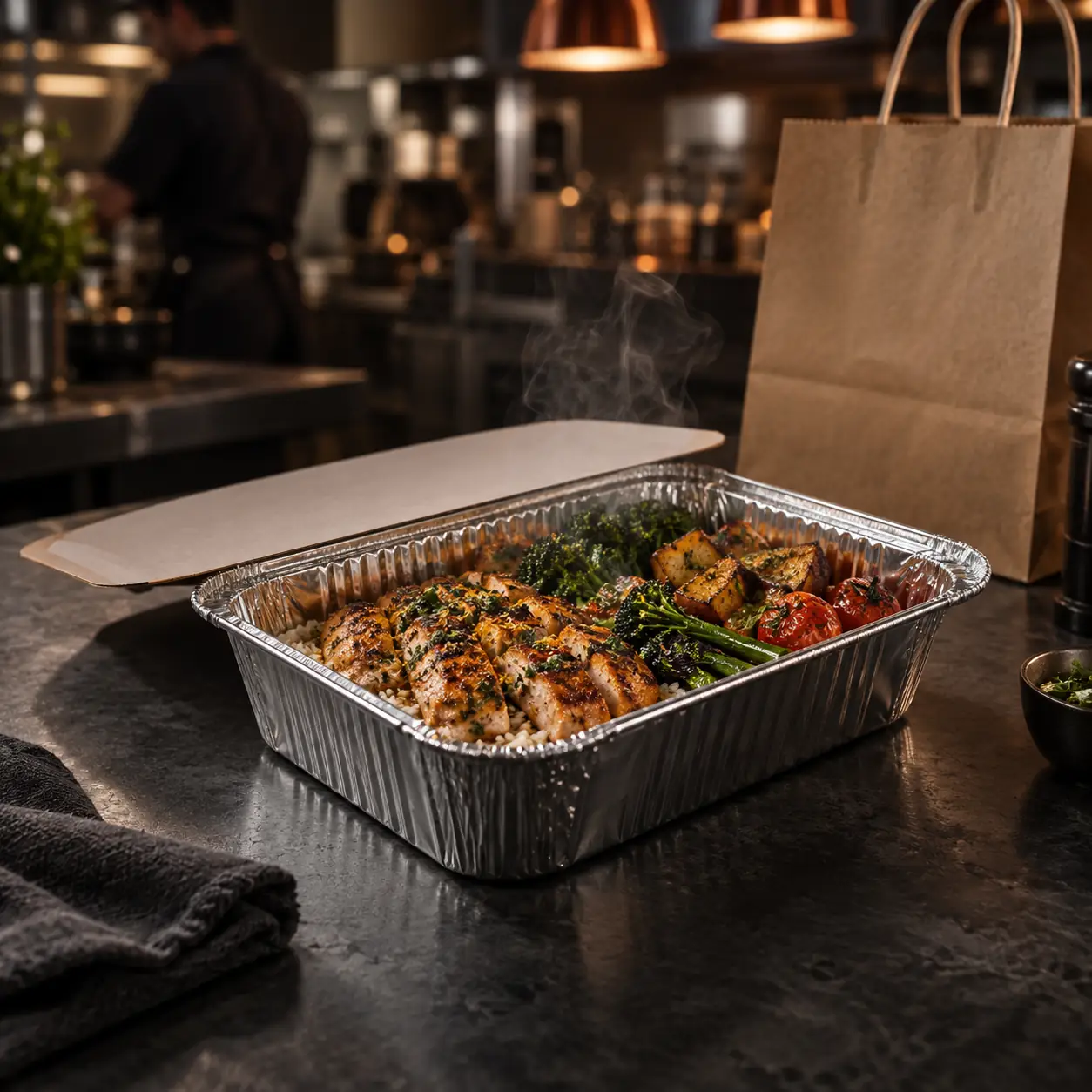
Takeout & Food Delivery
For restaurant takeout and meal delivery, compare portioned foil containers by food type, container dimensions, lid options, stacking needs, and transportation conditions.
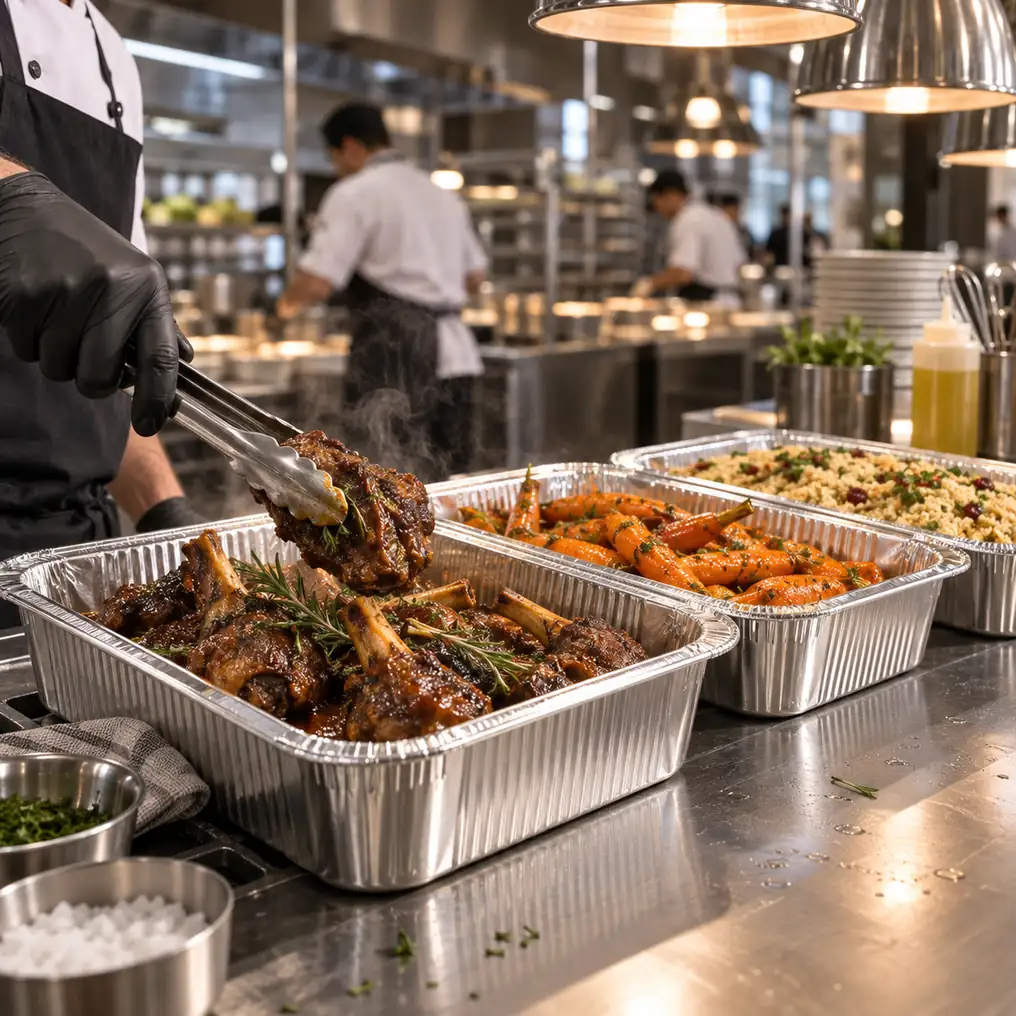
Catering & Foodservice
For banquets, hospitality, and institutional dining, review full-size and half-size foil pans, including pan depth, filled weight, handling, and service equipment compatibility.
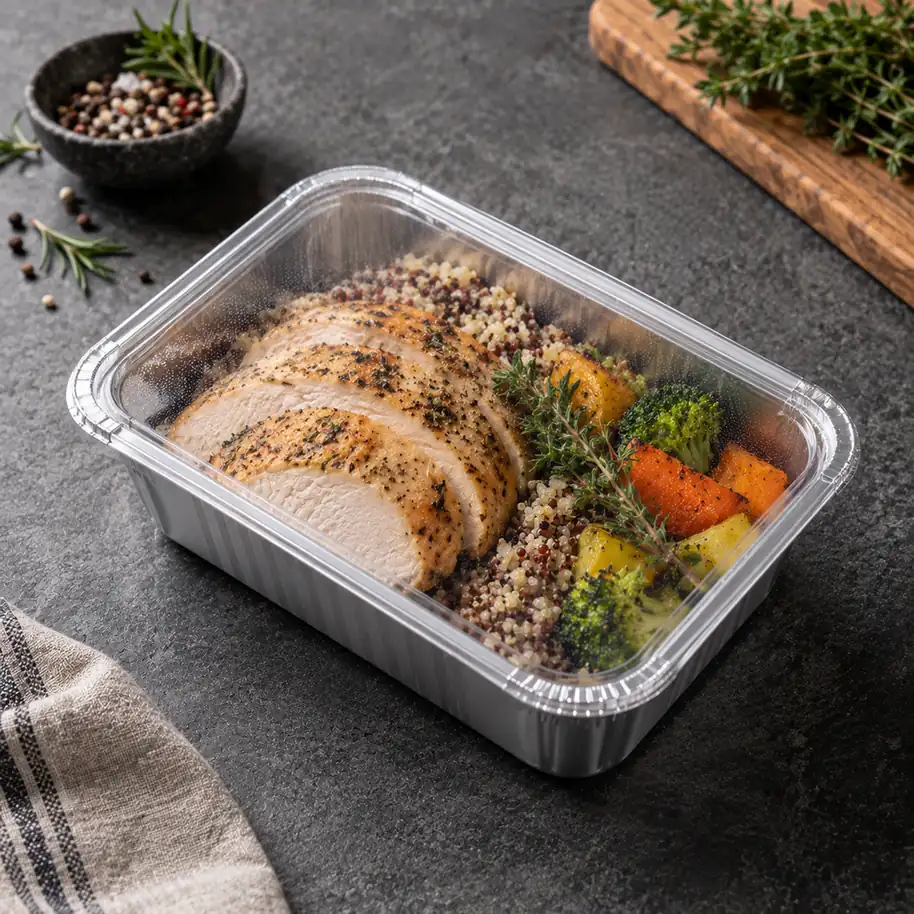
Commercial Bakery & Desserts
For pastries, tarts, pies, and desserts, review aluminum foil baking cups and pans by shape, filling volume, surface requirements, cooling, and presentation needs.

Ready Meals & Food Production
For central kitchens and prepared meal production, compare portioned containers and production pans against filling, closure, storage, distribution, and reheating requirements.
Ready Meals & Food Production
For supermarket deli counters and prepared-food retail, review portion containers and family-size pans with attention to presentation, lid fit, labeling, shelf space, and handling.
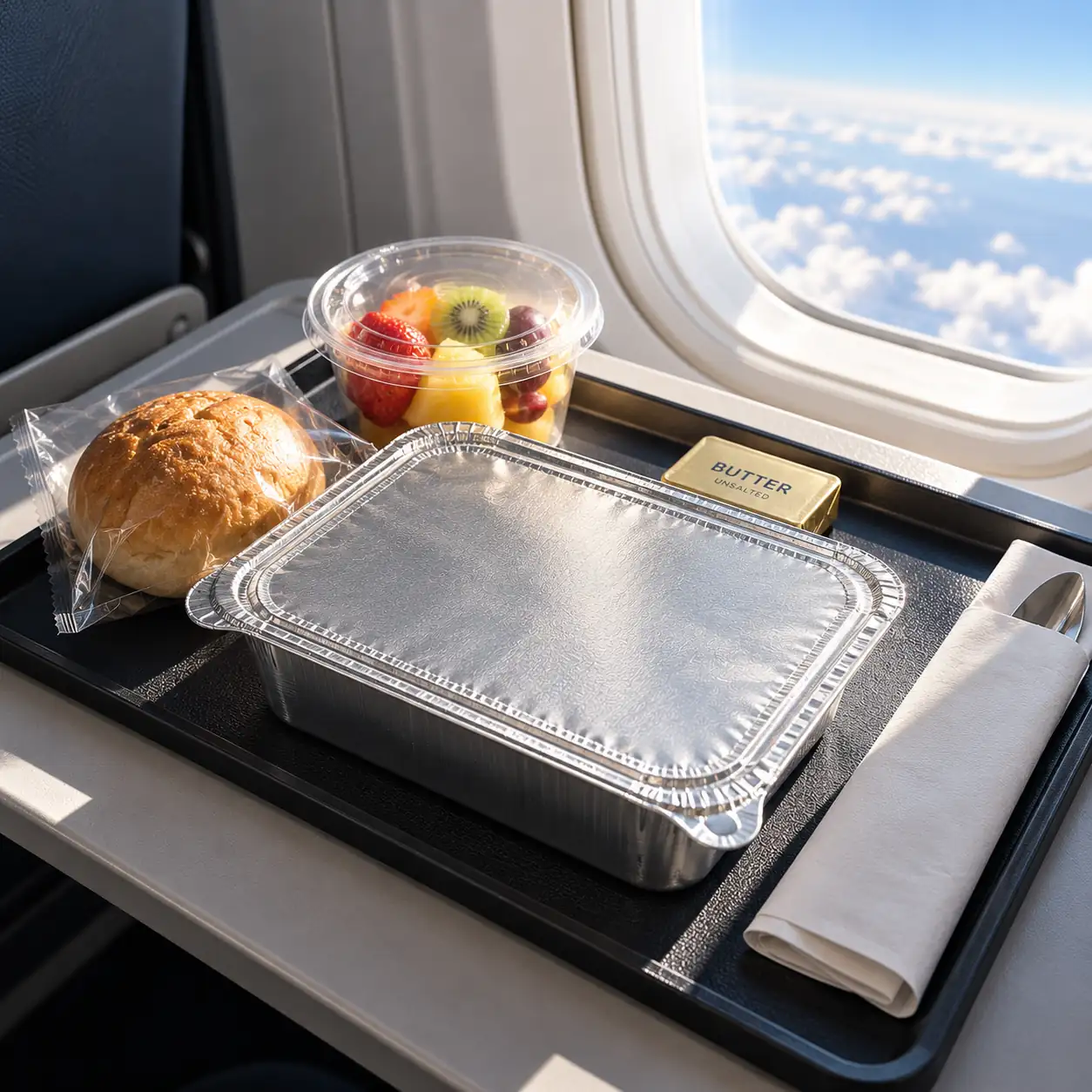
Airline Meal Packaging
For airline catering operations, review aluminum foil meal containers by portion size, dimensions, lid requirements, and handling conditions, with equipment fit assessed for each project.
PACKAGING SELECTION GUIDE
Find the Right Aluminum Foil Container for Your Food & Production Process
Select aluminum foil containers based on actual food characteristics, usable dimensions, foil thickness, lid compatibility, and operating conditions. Evaluate each container configuration against the complete packaging system before finalizing your specifications.
Already have a specific container format or capacity in mind?
Four Engineering Factors Behind Container Selection
Container selection begins with the food and its intended handling process—not an assumed capacity or thickness for a particular industry.
Four technical factors determine the initial specification:
01 — Size & Usable Capacity
Match container dimensions and usable volume to food geometry, filling weight, headspace, and lid clearance.
02 — Foil Thickness & Structure
Evaluate material thickness, alloy, temper, base span, reinforcement, and load distribution together.
03 — Lid Formats & Closure Integrity
Match lid materials, rim geometry, and closure methods to the required level of packaging performance.
04 — Operating Conditions & Compliance
Review filling, storage, transportation, heating, and food-contact requirements across the complete packaging system.
Engineering Principle
Specify the food, load, and operating conditions first. Then evaluate the container configuration as part of the complete packaging system.
PART I — Size & Usable Capacity
Aluminum Foil Container Dimensions & Usable Volume
Nominal capacity is only a starting point. Usable filling space depends on container geometry, food shape, filling depth, and closure clearance.
01. Five Critical Container Dimensions
| Dimension | Definition | Engineering Relevance |
|---|---|---|
| Outer Rim Dimensions | Overall length, width, or diameter including the rim | Equipment clearance, lid fit, and packing layout |
| Inner Opening Dimensions | Internal opening length, width, or diameter | Filling access and food placement |
| Base Dimensions | Bottom length, width, or diameter at defined measurement points | Food footprint, support, and stability |
| Overall Height | External container height | Equipment clearance and stacking |
| Usable Internal Depth | Internal depth available for food filling | Filling height, headspace, and lid clearance |
Containers with the same nominal capacity may have different base areas, depths, and rim profiles. Compare complete dimensions and tolerances when assessing a container configuration.
02. Three Capacity Definitions
Brimful Capacity
Volume measured to a defined filling level using an agreed method.
Nominal Capacity
Capacity stated in a catalog or product specification, subject to its measurement definition.
Actual Filling Capacity
Food volume accommodated under the intended filling, closure, presentation, and handling conditions.
Key Distinction
1,000 mL of container volume does not necessarily accommodate 1,000 g of food.
Food density, ingredient geometry, air spaces, and arrangement determine the relationship between weight and occupied volume.
03. Reference Capacity & Food Characteristics
Use these reference points to shortlist container geometries for evaluation.
| Reference Capacity | Food Characteristics & Handling Requirements | Primary Selection Check |
|---|---|---|
| 250 mL / ~8.5 US fl oz | Compact portions, irregular shapes, or raised toppings | Product height and lid clearance |
| 450 mL / ~15.2 US fl oz | Smaller portions requiring a broad footprint or additional depth | Base area versus usable depth |
| 750 mL / ~25.4 US fl oz | Mixed ingredients with different densities, moisture levels, or sauces | Portion arrangement and liquid movement |
| 1,000 mL / ~33.8 US fl oz | Larger or multi-component food portions | Filling depth, footprint, and headspace |
| 1,500 mL / ~50.7 US fl oz | Bulky, irregular, or heavier food loads | Food dimensions, base support, and lifting |
| 2,000 mL+ / ~67.6 US fl oz+ | Larger volumes with increased base span and handling loads | Structural support, load distribution, and equipment clearance |
US fluid ounces measure volume, not food weight.
04. Capacity Selection Checks
Portion Fit: Match the actual food weight and arrangement to the available internal dimensions.
Base Area: Determine whether additional horizontal space is more useful than greater depth.
Headspace: Allow for product height, filling variation, and required lid clearance.
Closure Fit: Verify rim geometry, dimensional tolerances, and lid engagement.
Handling Fit: Evaluate filled-container stability and space requirements during stacking and transportation.
Practical Selection Tip
When food does not fit properly despite sufficient nominal capacity, compare base footprint and usable depth first. The correct geometry may eliminate the need for a larger container.
PART II — Foil Thickness & Structure
Foil Thickness Conversion (mm, μm, mil & inch)
Foil thickness affects metal usage and container behavior. Structural rigidity also depends on alloy, temper, formed geometry, reinforcement, and handling support.
01. Thickness Conversion Reference
| Thickness (mm) | Micrometers (μm) | US mil | Inches |
|---|---|---|---|
| 0.04 | 40 | ~1.57 | ~0.00157 |
| 0.05 | 50 | ~1.97 | ~0.00197 |
| 0.06 | 60 | ~2.36 | ~0.00236 |
| 0.08 | 80 | ~3.15 | ~0.00315 |
| 0.10 | 100 | ~3.94 | ~0.00394 |
| 0.12 | 120 | ~4.72 | ~0.00472 |
| Above 0.12 | Above 120 | Above 4.72 | Above 0.00472 |
Unit Reference
1 mm = 1,000 μm
1 mil = 0.001 inch = 25.4 μm
Where a specification uses gauge, confirm the corresponding material thickness in mm or μm. Gauge terminology requires an agreed conversion basis.
02. What Determines Structural Rigidity?
Foil Thickness
Provides baseline structural resistance and material substance, but must be evaluated alongside container geometry, base span, and formed reinforcement.
Alloy & Temper
Material composition and temper influence forming behavior and must be considered alongside container geometry.
Base Span & Geometry
Wider unsupported bases may respond differently to loading and may require additional reinforcement or support.
Sidewall Reinforcement
Corrugations, formed ribs, and wall geometry can influence rigidity.
Rim Construction
Rim profile and forming quality affect handling, closure engagement, and resistance to local deformation.
Load Distribution & Support
Food weight, load concentration, lifting position, bottom support, and stacking conditions determine actual handling performance.
03. Thickness and Theoretical Aluminum Usage
For the same developed foil area and aluminum density, theoretical metal usage is proportional to material thickness.
Example: Increasing foil thickness from 0.06 mm to 0.08 mm
Relative metal usage increase:
(0.08 mm − 0.06 mm) ÷ 0.06 mm × 100% ≈ 33.3%
Theoretical aluminum usage increases by approximately 33.3% under these assumptions.
Finished-product pricing, carrying capacity, and transportation cost do not necessarily change by the same percentage.
Forming yield, coatings, lids, packaging configuration, and order requirements also affect the final cost.
04. Structural Evaluation Checks
Deformation Location: Identify whether deformation occurs at the base, sidewalls, corners, or rim.
Loading Conditions: Define food weight, temperature, distribution, and handling duration.
Support Method: Compare bottom-supported handling with lifting by the rim.
Stacking Loads: Evaluate expected loads and the duration of stacking.
Acceptance Criteria: Specify allowable deformation, rim condition, and closure performance.
Practical Selection Tip
Identify the source of deformation before increasing thickness. Base support, reinforcement geometry, or a revised lifting method may improve handling performance with less additional material.
PART III — Foil Thickness & Structure
Match Lid Materials, Rim Geometry & Closure Performance
A lid should be selected according to the intended food, rim profile, closure process, presentation requirements, and operating conditions of the container configuration.
01. Compare Common Lid Formats
| Lid Format | Selection Considerations | Engineering Check |
|---|---|---|
| Aluminum Foil Lids | Material structure, coatings, closure method, and rim compatibility | Verify retention, contact layers, and intended heating conditions |
| Transparent PET / APET Lids | Food visibility, lid height, material grade, and temperature limits | Confirm permitted temperatures and intended display conditions |
| PP Lids | Material formulation, container fit, and storage or reheating requirements | Verify the container configuration and applicable equipment instructions |
| Paperboard / Paper–Foil Composite Lids | Contact layers, coatings, printing, moisture exposure, and rim design | Assess closure retention, food-contact suitability, and handling |
02. Three Closure Methods
| Closure Method | Principle | Verification Requirements |
|---|---|---|
| Crimp / Fold-over | The container rim folds over a compatible lid | Rim geometry, lid dimensions, folding consistency, and retention |
| Snap-on | A formed lid engages mechanically with the rim | Engagement profile, dimensional tolerance, opening force, and retention |
| Heat-seal | Compatible lidding material is bonded to a prepared rim or flange | Material compatibility, sealing temperature, pressure, dwell time, and integrity |
The specified closure method must be assessed against the complete container configuration and intended process.
03. Transparent PET / APET Lids — Thermal Deformation & Oven Compatibility
Standard amorphous PET (APET) has limited high-temperature dimensional stability. As temperatures approach its glass-transition region, the material may soften or deform. Its heat-deflection behavior also depends on the specific material formulation and product construction.
Consequently, transparent PET / APET lids designed for chilled or ambient display are generally fitted after food has cooled and are not intended to remain on the container during conventional oven heating.
An oven-compatible aluminum container does not make its transparent PET / APET display lid oven-safe.
Remove a display-grade lid before oven heating. Any alternative lid-heating arrangement requires specific product documentation confirming suitability for the intended temperature, duration, and equipment.
04. Three Levels of Closure Performance
Leak-resistant
Limits liquid leakage under specified filling, tilting, stacking, or transportation conditions.
Airtight / Hermetically Sealed
Provides a verified level of closure integrity appropriate to the packaging system and its intended function.
Modified Atmosphere Packaging (MAP)
Requires a packaging system capable of maintaining the specified internal gas atmosphere under defined conditions.
These requirements are not interchangeable.
For each application, select the relevant verification method: liquid containment, seal integrity, or gas-atmosphere retention.
Food shelf life also depends on formulation, processing, hygiene, temperature control, and distribution.
05. Closure Verification Checks
Fit: Confirm actual rim geometry, dimensions, and tolerances.
Method: Define crimping, snap-on closure, or heat-sealing requirements.
Performance: Specify the necessary retention, leakage, or seal-integrity criteria.
Handling: Assess closure behavior after filling, stacking, and transportation.
Thermal Conditions: Confirm whether the lid remains in place during storage, heating, or service.
Practical Selection Tip
Define the required closure performance before selecting a lid. Spill control, hermetic sealing, and atmosphere retention are separate engineering objectives requiring different verification methods.
PART IV — Operating Conditions & Compliance
Evaluate the Complete Packaging System
Packaging suitability depends on the conditions encountered from filling through final food preparation and service.
01. Packaging Process Assessment
Food Composition → Filling → Closure → Cooling / Freezing → Storage & Stacking → Transportation → Reheating / Service
| Process Stage | Key Requirements |
|---|---|
| Food Composition | Acidity, salt, oil, moisture, and food-contact conditions |
| Hot / Cold Filling | Filling temperature, actual food weight, and headspace |
| Closure | Crimping, snap-on engagement, heat sealing, and equipment compatibility |
| Cooling / Freezing | Temperature changes, container integrity, and lid retention |
| Storage & Stacking | Storage duration, temperature, support, and stacking load |
| Transportation | Vibration, tilting, compression, and repeated handling |
| Reheating & Service | Equipment mode, heating conditions, lid handling, and safe removal |
02. Microwave & Oven Thermal Regimes
Oven suitability does not establish microwave suitability.
Verify the intended equipment, operating mode, temperature, duration, food load, and complete container configuration.
Heating instructions should specify:
- Container and lid identification.
- Permitted equipment and operating mode.
- Temperature, power, and duration limits.
- Food type and filling quantity.
- Coating and food-contact surface conditions.
- Lid removal, loosening, or venting requirements.
Microwave use requires explicit compatibility between the specific packaging system and the appliance instructions.
03. Acidic & High-Salt Food Contact
Acidic and salty foods can increase aluminum release under relevant contact conditions.
Examples include tomato-based sauces, citrus-containing foods, concentrated brines, and salty marinades.
The German Federal Institute for Risk Assessment (BfR) identifies these food characteristics as important considerations for uncoated aluminum food-contact articles.
For relevant applications, evaluate a suitable protective organic coating or alternative contact material.
Confirm food composition, pH where relevant, salt concentration, contact temperature, duration, and the suitability of the proposed food-contact surface.
A coating must be assessed for the actual food and operating conditions; its presence alone does not establish corrosion resistance or food-contact compliance.
04. Compliance Framework & Verifiable Documentation
Food-contact requirements must be evaluated against the destination market, actual material structure, and intended operating conditions.
| Regulatory Framework | Key Requirements | Documentation to Verify |
|---|---|---|
| EU — Regulation (EC) No 1935/2004 | General food-contact safety framework; applicable specific measures determine additional obligations | Food-contact compliance statement and Declaration of Compliance (DoC) where legally required |
| EU — Regulation (EU) 2024/3190 / (EU) 2026/250 | Applicable restrictions on BPA and specified bisphenols in relevant food-contact materials, including certain coatings and varnishes; review transitional provisions | Applicable coating and material declarations, substance information, and supporting compliance evidence |
| US FDA — Food Contact Substances (FCS) | Confirm the regulatory status of relevant food-contact components and their authorized conditions of use | Applicable regulatory references, effective Food Contact Notifications (FCNs) where relevant, and component-specific supporting documents |
| Council of Europe / EDQM — 2024 Technical Guide | Metal-release evaluation; recommended specific release limit for aluminum: 5 mg/kg food | Metal and aluminum release test reports, including test conditions and comparison with applicable guidance |
Each declaration and test report should identify the material or component assessed, applicable requirements, intended food-contact conditions, and relevant limitations.
The EDQM aluminum release value is a technical reference and should not be presented as a universally binding EU statutory limit. Applicable national requirements must also be considered.
Last updated: November 2026. Regulatory references do not establish product-specific compliance; supporting records and applicable requirements must be checked for the actual packaging system.
05. Final Operating-Condition Checks
Food Contact: Confirm the relevant contact surface and material evidence.
Process: Document filling, closing, cooling, storage, and distribution conditions.
Heating: Define the permitted equipment mode and lid-handling requirements.
Documentation: Match test reports and declarations to the specified materials and intended use.
Practical Selection Tip
Include heating mode, contact duration, lid-handling instructions, and food-contact limitations in the final technical specification. These details define how the packaging system is intended to be used and assessed.
Start Your Engineering Evaluation
A complete specification brief helps establish the intended container configuration and identify the technical details requiring further evaluation.
Fill in your known requirements; items marked “to be advised” will be evaluated by our engineering team.
Packaging Specification Brief — 10 Key Parameters
| Parameter | Information to Provide |
|---|---|
| 01 — Food Type & Composition | Food description, physical form, moisture, pH or acidity where known, and salt content |
| 02 — Target Filling Weight | Actual portion weight in grams (g), food arrangement, and required headspace |
| 03 — Container Dimensions | Outer rim, inner opening, base dimensions, overall height, and usable internal depth in mm; drawings or samples if available |
| 04 — Capacity Requirement | Target capacity in mL and its measurement basis, if known, or to be advised by MUNWEY |
| 05 — Foil Material Specification | Preferred thickness, alloy, temper, and tolerances, if known, or to be advised by MUNWEY |
| 06 — Surface & Coating Requirements | Preferred contact surface, coating requirements, and relevant food-contact conditions |
| 07 — Lid & Closure Method | Lid material, preferred closure method, and any existing lid or equipment reference |
| 08 — Thermal & Storage Process | Hot or cold filling, refrigeration or freezing, storage duration, and intended heating conditions |
| 09 — Handling & Equipment Requirements | Filled load, stacking, transportation, equipment clearance, and relevant filling or sealing machinery |
| 10 — Purchase & Project Details | Estimated quantity, purchasing frequency, destination market, and available technical drawings or reference samples |
Share your existing specifications, drawings, samples, or application requirements with MUNWEY. We can review the information provided, identify points requiring clarification, and discuss suitable product formats and next steps.
Our team will respond within 24 hours of receiving your requirements. We will then discuss the technical details and next steps based on your project needs.
Explore Our Aluminum Foil Containers
Browse MUNWEY’s aluminum foil container range to explore available product formats, sizes, and specifications.
The capacity examples and engineering guidance on this page are provided for preliminary selection only. Actual product specifications, availability, performance, and food-contact suitability must be confirmed for the selected container and lid combination, intended food, and operating conditions.
MANUFACTURING & OEM/ODM CAPABILITIES
Aluminum Foil Packaging Manufacturing & Customization
MUNWEY brings together foil preparation, surface treatment, container forming, and foil roll production to support standard packaging formats and evaluate custom requirements, including compatible lidding options.

From Standard Formats to Custom Packaging Requirements
MUNWEY reviews packaging requirements to identify suitable existing formats and determine when further customization assessment is needed.
- Design Inputs: Target dimensions, reference samples, and optional 2D/3D drawings.
- Existing Formats: Aluminum foil containers, foil rolls, and applicable lidding options.
- Customization Review: Non-standard dimensions, configurations, and tooling requirements for further OEM & ODM assessment.
Technical Scope: Requirements Review · Existing Formats · Customization Assessment

Material Options for Different Packaging Requirements
MUNWEY reviews available material options according to the selected packaging format and intended application.
- Alloy Options: 8011 and 3003.
- Temper Options: O, H22, and H24.
- Surface Options: Plain, lubricated, and lacquered aluminum foil.
Material Options: 8011 / 3003 · O / H22 / H24 · Foil Thickness · Plain / Lubricated / Lacquered

From Foil Preparation to Finished Packaging
MUNWEY’s foil processing and manufacturing capabilities connect material preparation with aluminum container forming and foil roll production.
- Foil Processing: Slitting, annealing, rewinding, and roll preparation.
- Surface Treatment: Lubrication and coating for applicable material and production requirements.
- Forming Control Points: Drawability, thickness consistency, wall integrity, and rim tolerances evaluated against product requirements.
Manufacturing Capabilities: Foil Converting · Surface Treatment · Container Forming · Foil Roll Production & Packaging

Product-Specific Quality & Documentation Requirements
Quality review focuses on the product characteristics, inspection criteria, and documentation relevant to each packaging application.
- Product Checks: Dimensions, rim geometry, surface condition, and applicable lid or sealing-interface fit.
- Inspection Requirements: Thickness, dimensional tolerances, and AQL-based sampling where agreed.
- Documentation: Product-specific food-contact declarations and batch-linked records where applicable and available.
Verification Scope: Dimensional QC · Rim & Lid Fit · Inspection Criteria · Food-Contact Documentation
| Procurement Metric | Manufacturing & Commercial Information |
|---|---|
| Quality & Compliance | ISO 9001:2015 certificate on record · Product-specific FDA/EU food-contact documentation assessed for applicability |
| Tooling Lead Time | Schedule provided following tooling feasibility and design review |
| Sample Turnaround | Sample availability and delivery schedule provided upon request |
| Production Capacity | Aluminum foil container forming and foil roll production lines · Available volume assessed by product format and production schedule |
| Minimum Order Quantity (MOQ) | Standard catalog baseline: from 300 cartons · Custom tooling, materials, and finishes assessed separately |
Explore OEM & ODM Capabilities
Learn more about MUNWEY’s customization options, tooling considerations, and project development process.